
The Beauty of Thermal Mass (more about the buffer tank dump load)
Turning excess solar production into heat is near the top of the list for ways to use that excess energy, which is why I installed the buffer tank with electric heating elements (see that post for more info). But when it comes to storing that heat, you must rely on thermal mass. While people talk about all sorts of sometimes "exotic" approaches for that (giant water tanks, huge amounts of sand, etc.), it's pretty hard to beat a big ol' slab of concrete with water-filled PEX tubes running through it (i.e., radiant hydronic heat). Here's an example.
It hasn't been above 18F here in midcoast Maine for several days as I write this in early January of 2026 and it's just below 0F right now. But look at this screenshot of our garage temps and thermostat settings:
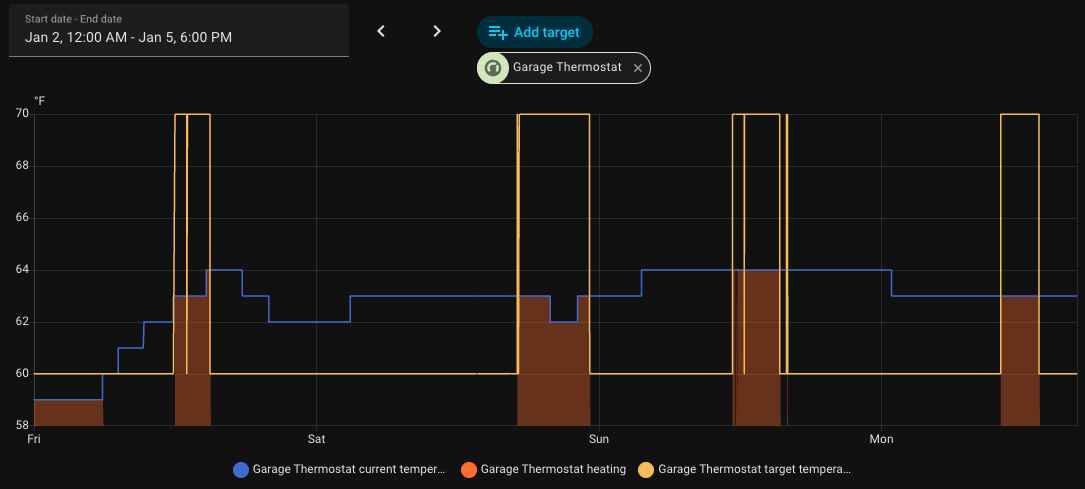
The yellow line is the thermostat set point, which we keep at a very comfy 60F because we work in the garage fairly often. But when we have excess solar production, Home Assistant raises the set point to 70F and turns on the electric heaters in the buffer tank. That's what you see with the red-brown shaded area (after that first shaded area, which is when the propane boiler kicked on because the temperature fell below 60F). When we raise the set point and turn on the buffer tank heaters, which Home Assistant does automatically, it allows us to convert excess solar into heat, which we store in the thermal mass of the slab. We never get to 70F because we're starting at 60F and that would take a lot of energy (and time), but that's not the point. We just want to keep the system running as long as we have excess solar production available because we're heating up the slab without having the propane boiler come on. And because that heat is given off very slowly (another property of large thermal mass storage), the building never overheats. BTW, the small dips in set point (back to 60F) were just me, making and testing some adjustments in Home Assistant automations. Normally you just see the set point go to 70F and back to 60F, which is a rather reliable indicator of the weather that day. If it stays at 60F, it wasn't very sunny that day.
The blue line is the actual garage temperature (64F for quite some time, then down to 63F overnight). As you can see, we haven't been below 60F (which causes the propane boiler to run) since the early morning hours of Jan 2 - three days ago! - during a period when the temps haven't even reached 20F during the day. We've used solar for every BTU generated for that garage heat since then, and it sure made working in there nice over the weekend.
So, if you live where it gets cold and are thinking of building a new building, you might want to think about having the ability to generate an EXCESS of ~ 7-8KW or more of solar energy on sunny winter days (panels are now the cheapest major component of a solar energy system), and having the ability to capture and store that heat using thermal mass. It doesn't add much to the cost if you do this as you're designing and building the building, and it's a great way to save energy and money while also enjoying a very comfortable building. Some will say, but a heat pump is so much more efficient, and they’re absolutely correct. In fact, we have an air-to-air heat pump in the garage. But nothing beats a radiant slab for a garage in winter because the warm floor makes the snow and ice melt evaporate quickly (usually overnight), days faster than that would happen if the slab weren’t heated. An air-to-water heat pump would be fantastic, but they cost a fortune here in the US. We needed the buffer tank anyway, so it was a small additional expense to install the automation and additional plumbing to make this work. If air-to-water heat pumps that will work well in very cold weather drop in price significantly, we’ll put one in. But until then, we’ll just rely on our big ol’ slab of concrete and some nice, sunny days of excess solar production.